Wednesday, January 19, 2011

Homework 1-19-11

Use the pH paper to develop a table and graph of the pH of common things around your home. (Think in terms of atleast 10 different liquids)

          Liquid
pH1
pH2
pH3
pH4
pH5
pH6
pH7
pH8
pH9
pH10
1.       Water


X


2.       Beer


X


3.       Shampoo


X


4.       Red bull


X


5.      Lemonade
X


6.       Milk


X


7.       Contact Solution


X


8.       Mouth Wash


X


9.       Jack Daniels


X


10. Jagermeister

X


Develope an expriement to see how much antacid is needed to neutralize an acidic liquid. Only 1 liquid!For my experiment, i used milk and tums.

For your liquid, how many tablets do you need to take? Only 1 liquid!For tums, it takes about 1 tabelts to neutralize milk.


Activity 5 1-19-11

pH3 compared to pH4.

Which one is more acidit? pH3

By How many times more? pH3 is 10 times more acidic then pH4

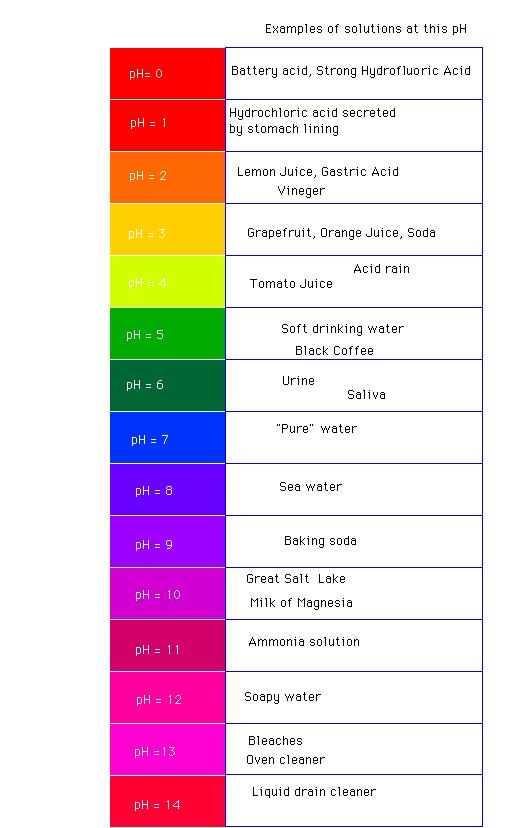
Describe pH, present a table of pH ranges for some common things.

Activity 4 1-19-11

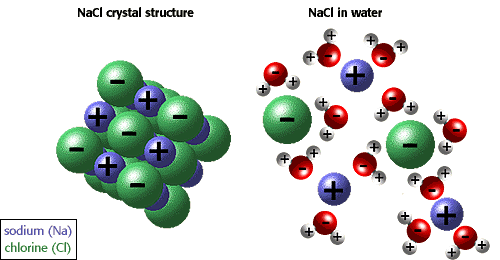
Show an image or animation or description of what is happening when water dissolves NaCl.


The sodium ions are attracted to the oxygen atoms of the water molecules

Why is the freezing point lowered when salt is added to water?
When salt is added to water it lowers the freezing point because the water molecules will form crystals when freezing. The positive(Na) and negative(Cl) ions from the salt get in the way of the water molecules, making it harder for the water molecules to become crystals again. This then means that salt water remains in a liquit state for longer as the temperature reduces


Activity 3 1-19-11

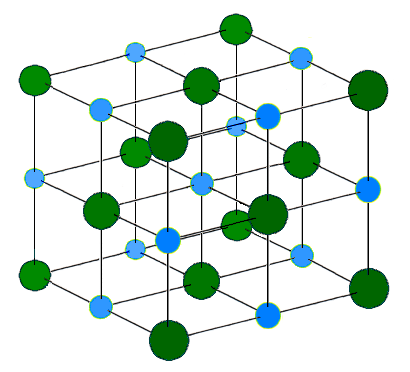
1.Show crystal structures for NaCl (sodium chloride) and CaCO3 (calcium carbonate). What is the melting point for these two materials?

NaCl (sodium chloride)Here are two pictures i found for the crystalalized structure of sodium chloride.


Its melting point is 801 degrees C or 1474 degrees F
CaCO3 (calcium carbonate).
Here is a picture of the crystalized structure of calcium carbonate.
File:Calcium-carbonate-xtal-3D-vdW.png
The melting point for this is 825 degrees C. (Calcite)
1339 degrees C (aragonite)
1115K (842 degrees C or 1548 degrees F)

Activity 2 1-19-11

1. Describe some common weather occurences in relation to the gas laws and characteristics we have been exploring.
Some common relationships with weather we can talk about is the expansion of molecules and this will happen if the sun is shinning down on the earth and their are no clouds in the sky. The sun will shine everywhere and take the air and it begins lighter. This happens especially when the sun goes over a body of water and it is warm outside. The opposite of this would be when the sun is and taking the water vapor up into the sky and producing snow. Snow happens when it is cold out and if the ground is frozen, it will then stick to the ground and thats when its Winter. The first few snowfalls usually dont stick to the ground unless its previously been frozen from cold days ahead of time.

Last year when it snowed in May, there was so much snow that it insalliated the other snow falling on it, but as the snow on the ground began to melt the other snow was falling in the water and hitting the warm ground causing it all to melt. I would have to agree, having snow in May was very different and my birthday is in may, so i would especially been mad if there was snow on my birthday!


2. What is the bernouli principl, provide an example or application of this.
Related to why airplanes fall. Molcules moving fast over and under the wing of the airplane.

When doing some research on the internet, i found that Bernoullie had studdied the type of relationship of speed of a fluid and speed of pressure. In the explaining i was able to identify that when you have pressure of the fluid it descreases and vice versa of the speed increasing.

An example if found of this principle is an airplane wing. The top is curved, so the air traveling over the top of the wing needs to travel faster than the air going along the bottom. As the velocity of air increases the pressure decreases.

Activity 1 1-19-11

Gases
-far apart- cooling of balloon
-density different- based on density molecular determines weight
-lots of movement- simulation
-diffusion-rather slow, bumping into one another
-Naming of common
Ideal Gas Law
-PU= nRT
     -p-presure
     -v-volume
     -n-moles of gas
     -t-temperature
     -r-gass constant
     -P1V1/N1t1=P2V2/n2T2
          -Condition "1" and Condition "2"
-example- with a balloon when you increase the temperature the volume goes up. If you decrease the temperature the volume will go down. (Direct Relationship)
-example- what will happen in a balloon when you decrease the pressure the pressure will increase or balloon will expand. (Inverse Relationship)
-example- when you add molecules to the balloon it will expand and they go together. ( Direct Relationship)

1. What is the tire pressure at -20 degrees F compared to 90 degrees F, assuming the starting pressure was 32 psi?
32 psi/305.2k=psi/244k
     psi= 32psi(244.26K)
                305.2 K
     psi=25.61 psi

Tuesday, January 18, 2011

Homework 1-18-11

1.How much does water expand? I found this very difficult to measure due to my cup and i wasn't sure how it was actually meant by measuring if wate ractually expanded, but when i started i did measure the length of the top of the cup to see how long it was and the length was

approximatley 3 inches long. It was also the same on the top at the end of the expirment.

After looking online for awhile i was able to find that water will expand and this because when its freezing it is better off to make hydrogen bonds while turning to ice.

2. When is water the smallest? What is the temperature?Truthfully, i have no idea when water is the smallest, but if stated above if water expands around freezing temperatures i would best guess that water is the smallest when it is around room temperture. Room temperature would allow it to be activie and still make shapes but no raise the tempeature or the height of the water.


3. What happens when salt is added to water?    
     When you put salt on frozen water an endothermic reaction takes place. this then decreases the temperature of the water.
4. Does the amount of salt added affect the freezing point of water?

     Yes, because it dops the freezing point forcing the temperature to drop in order for the water to re freeze allowing the salt to stop working.


Experiment


Time
Temperature in Cup
Temperature Outside
How thick is the ice in cm?
5:00 pm
18 degrees C or 64 degrees  F
16 degrees F
n/a
5:30 pm
5 degrees C or 41 degrees  F
14 degrees F
n/a
6:00 pm
1 degrees C or 34 degrees  F
14 degrees F
0.1 cm
6:30 pm
1 degrees C or 34 degrees  F
14 degrees F
0.2 cm
7:00 pm
1 degrees  C or 34 degrees  F
14 degrees F
0.3 cm
8:00 pm
1 degrees  C or 34 degrees  F
14 degrees F
0.6 cm
9:00 pm
.5 degrees C or 33 degrees F
14 degrees F
1.0 cm

10:00 pm
.5 degrees C or 33 degrees F
14 degrees F
1.3 cm
2 cups of water were placed in a plastic up. Before the water was put outside at 18 degrees C or 64 degrees F I added 1 tsp of salt into the cup and the water dissolved the salt allowing it to disappear. After seeing what it did at 18 degrees C or 64 degrees F I then washed the cup out and put new water in it and got that water to the same temperature as before and put that water outside. On the graph above, it shows the water at different times and temperatures through the night.

At 10:00 pm I took the ice in from outside and decided to sprinkle the 2 tsps of salt on top of the ice to see what will happen. After putting the first tsp on the ice and getting the second tsp ready, the ice began to crack and make cracking sounds.  This graph shows what I saw every 15 minutes for 1 hour after putting the salt on the ice.

Time
Description of what I saw and heard
10:00 pm
Cracking of the ice began after putting 2 tsp. of salt on the ice.
10:15 pm
Looks like there are little bubbles in the ice, but there just actually grooves in the ice. I also added an additional tsp. of salt.
10:30 pm
When looking at the cup again full of ice, I saw that there was little water on top with a lot of ridges.
10:45 pm
After another 15 minutes, there was more water sitting on top of the ice and you could still see the little bumps or ridges on the ice. I did add another 1tsp. of salt to see what that would bring.
11:00 pm
After observing for the last time of ice,  there was more water on top of the ice and the bumps/ridges were still there but slowing going away as it begins to melt.

At 11:00 pm i brought the cup inside to allow it to melt and when i woke up in the morning at 8:00 am the temperture inside the cup was 20 degrees C or 68 degrees F. The cup changed to room temperture because the heat inside my apartment is at 68 degrees F.